

A Night of Glory in Paris
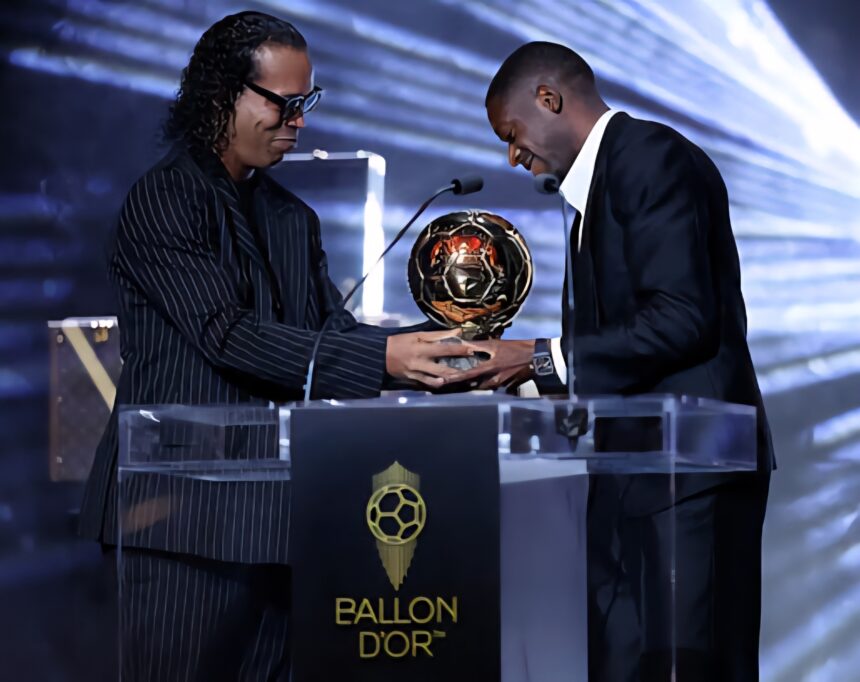
On Monday, September 22, 2025, the Theatre du Châtelet in Paris was lit with golden lights, history, and emotion. The world watched as Mansour Ousmane Dembélé, once regarded as football’s “nearly man,” rose like a phoenix from the ashes of injuries and doubt to lift the Ballon d’Or.
For many, his coronation as the best footballer in the world was not a surprise. It was the culmination of years of raw talent, crushing setbacks, quiet perseverance, and a remarkable rebirth in Paris. This is not just the story of a trophy; it is the story of resilience, reinvention, and the power of belief.
Early Spark: A Boy with a Dream
Born in Vernon, France, in 1997 to a Mauritanian-Senegalese mother and a Malian father, Ousmane Dembélé’s story reflects the multicultural richness of modern football. Like many children with African heritage growing up in France, football was more than just a sport — it was a language, a dream, and a passport to the world.
From kicking balls in the narrow streets of Vernon to polishing his skills at local clubs ALM Évreux and Évreux FC 27, Dembélé showed early promise. Coaches described him as a player with both flair and fearlessness, able to use either foot with rare confidence.
In 2015, his talent blossomed at Stade Rennais (Rennes). With 12 goals in 26 matches, he quickly became one of France’s brightest young prospects. His performances attracted the attention of Borussia Dortmund, a club famous for nurturing young talent.
Borussia Dortmund: Glimpses of Greatness
In the 2016/2017 season, Dembélé joined Dortmund, and it was here that Europe saw his dazzling skill set on the big stage. Playing alongside stars like Pierre-Emerick Aubameyang, Dembélé recorded 6 goals and 13 assists in the Bundesliga, helping Dortmund win the DFB-Pokal.
While his numbers were modest, the flashes of brilliance — explosive dribbles, unpredictable turns, and ambidextrous shooting — confirmed his status as one of the continent’s brightest young stars. It was only a matter of time before Europe’s giants came calling.
Barcelona and the Weight of Expectation
When FC Barcelona signed Dembélé in 2017 for a staggering €105 million, he was heralded as the natural heir to Neymar, who had just left for PSG. Expectations were sky-high, but fate had other plans.
Dembélé’s time in Catalonia was plagued by misfortune. A string of injuries disrupted his rhythm, leaving him sidelined for months at a time. Soft tissue injuries, hamstring tears, and setbacks became recurring nightmares.
Between 2017 and 2023, he managed only 24 goals in 127 La Liga appearances, far below what many expected of a €100m forward. Though he tasted international success with France’s World Cup victory in 2018 and reaching the final in 2022, his club career stagnated.
For critics, Dembélé seemed destined to be one of football’s “what could have been” stories.
PSG: The Road to Redemption
The turning point came in 2023, when Dembélé made the bold decision to leave Spain and return home to France, signing for Paris Saint-Germain. It was more than a transfer; it was a return to his roots.
Under Luis Enrique, PSG began to unlock the best version of Dembélé. Initially used as a winger, his versatility soon became his greatest weapon. When Kylian Mbappé departed for Real Madrid in 2024, Enrique handed Dembélé more responsibility and freedom.
The result was nothing short of spectacular. In the 2024/2025 season, Dembélé recorded 35 goals and 16 assists across all competitions, guiding PSG to a historic treble:
Ligue 1 title
Coupe de France
UEFA Champions League
UEFA Super Cup
He was also named UEFA Champions League Player of the Season, cementing his status as PSG’s talisman.
The only blemish was PSG’s defeat to Chelsea at the FIFA Club World Cup, but by then, Dembélé had already etched his name among football’s elite.
Ballon d’Or 2025: A Crown of Redemption
On that September evening in Paris, Dembélé’s journey came full circle. From the boy in Vernon to the injury-ridden years at Barcelona, to the resurgence in Paris — the Ballon d’Or was more than a trophy; it was vindication.
By winning the award, Dembélé joined an exclusive club of players who have lifted the World Cup, the Champions League, and the Ballon d’Or. Even more significant, he became only the fourth player of African heritage to win the golden ball, after:
Eusébio (1965, Portugal, Mozambican descent)
George Weah (1995, Liberia)
Karim Benzema (2022, France, Algerian descent)
Dembélé’s triumph resonated far beyond France. For millions of aspiring footballers across Africa and the diaspora, his story became proof that setbacks are not the end — they can be the beginning of something greater.
What Makes Dembélé Special
So why did Ousmane Dembélé succeed where others might have faded away? Several factors stand out:
1. Ambidexterity: Rarely can a forward use both feet equally well. Dembélé’s ability to dribble, pass, and shoot with either foot makes him unpredictable.
2. Resilience: Despite six injury-ridden years at Barcelona, he never gave up on his dream.
3. Adaptability: At PSG, he evolved from being a winger into a versatile forward capable of drifting inside, creating, and finishing.
4. Work Ethic: Behind the flair lies a player who rebuilt his fitness, discipline, and mentality.
Conclusion: The King of Paris, The Hero of Football
Ousmane Dembélé’s Ballon d’Or victory is more than a football achievement; it is a human story of falling, rising, and shining brighter than ever.
He is not just a champion of France or PSG, but a symbol of global football — a reminder that even when the world doubts you, perseverance can rewrite destiny.
As the Theatre du Châtelet crowned him on that magical night, the football world saluted not only a great player but also a great comeback story.
- Congratulations to the new king of world football, Mansour Ousmane Dembélé.